Shrinking Lake Kainji puts Kebbi irrigation farming, food supply at risk
FARMERS in Kebbi State are cutting down on cultivated land, abandoning fields and taking on more debt as declining water levels around Lake Kainji disrupt irrigation farming across communities in Yauri and Ngaski Local Government Areas, The ICIR reported.
For decades, communities around Tondi, Tillo and other areas of Yauri relied on water channels connected to Lake Kainji to cultivate rice, onions, pepper, maize and vegetables throughout the year.
But farmers say the water has receded significantly in recent years, forcing them to stretch irrigation pipes across longer distances, spend more on petrol and pumps, and in some cases abandon their farms altogether.
The development is threatening the livelihoods of farming households in one of Nigeria’s major food-producing states at a time when the country is already battling high food prices and food insecurity.
Before sunrise in June 2026, farmers in Tillo arrived at their farms carrying irrigation pipes and hoes, only to discover that the water had receded farther from the riverbank.
For 88-year-old Adamu Tillo, who has farmed along the lake for decades and chairs the Farmers’ Association covering communities from Tondi to Kwashmalo, the change represents a sharp departure from the past.
“Back when I was young, we used to get enough water from this lake and could comfortably practice dry-season farming,” he said.
“But now, while we are still farming, the lake has dried up, and a farmer struggles to harvest even one-third of what he planted.”
Tillo said farmers now face a difficult choice between relying on rainfall, which can expose crops to flooding, and paying increasingly high costs to pump water to their farms.
“Honestly speaking, farming is declining now because every year seems worse than the previous one,” he said.
READ ALSO: Food crisis’ll persist without water, tech, political reforms – ex-Adamawa commissioner
Farmers abandon portions of farmland
The retreating water has already affected crop yields. Idris Abdullahi, 66, who cultivates about two hectares, said farmers now have to use several lengths of pipes to transport water from distant wells to their farms.
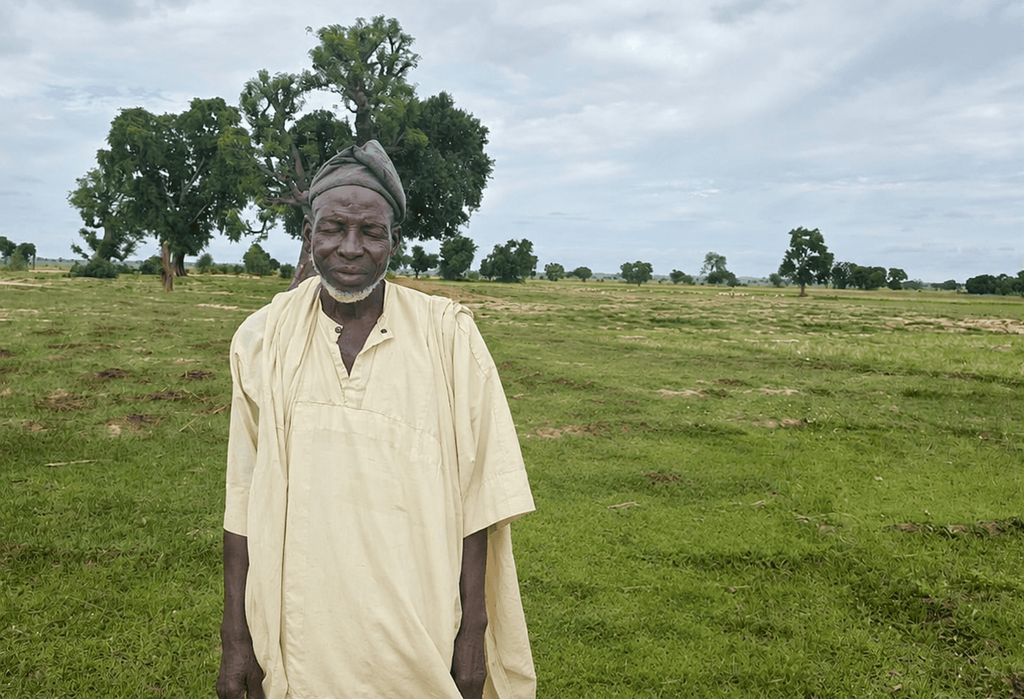
Adamu Tillo on his farmland, which he says has suffered from dwindling water supplies from Lake Kainji.
He pointed to rice plants that appeared healthy but had produced heads containing little or no grain.
“The rice did not perform well; only a small amount will be harvested from this area,” Abdullahi said.
He said the water shortage had forced him to abandon parts of his farmland and eventually sell them to herders for grazing.
The impact has also extended to maize, onions and pepper.
“This year I planted dry-season maize, but just as the maize was beginning to tassel, the water receded,” he said. “The same happened to the onions.”
Abdullahi said his pepper farm, which previously generated between N2 million and N3 million annually, now produces only a fraction of that amount.
He used to harvest between 15 bags and 20 bags of pepper per market cycle but harvested just three bags during the last cycle.
Tillo said the decline in productivity has been equally severe on his farms.
According to him, farmers who once harvested as much as 200 bags of rice now struggle to obtain about 50 bags from comparable plots.
Water shortage raises farming costs
As the lake recedes, irrigation itself is becoming more expensive. Farmers who previously relied largely on floodwater and residual moisture now depend increasingly on petrol-powered pumps, long pipes and wells.
Shehu Tsamiya Hazjazu, 28, said farmers in Tondi previously had limited irrigation expenses because water remained close to their farms.
“We started using irrigation pumps to draw water from the lake because the water no longer remained for long periods,” he said.
“But bringing water from a far place means buying pipes and spending more money on petrol.”
Muhammad Ahmad, a farmer in Old Tondi, said fuel costs can rise sharply when water moves farther away from farms.
“When water is available, you may spend between N17,000 and N20,000 on fuel,” he said. “But once the water recedes and irrigation becomes difficult, fuel expenses can rise to N28,000 or N30,000.”
Farmers also face difficulties accessing groundwater.
Ahmad said attempts to dig wells in the area have often been frustrated by underground rock formations.
“We attempted to construct wells. Even after installing one to five pipes, workers often hit solid rock,” he said.
For some farmers, the rising cost of irrigation is consuming money that would otherwise be used to feed their families. Hazjazu recalled one season when he could not afford enough petrol to irrigate his rice farm.
“The rice had already formed heads, but I had no money to buy petrol,” he said.
“While I watched helplessly, pests invaded and destroyed the crop, and I harvested nothing.”
READ ALSO: Nigeria’s grazing land, food systems in danger as climate change impact spreads
Repeated losses push farmers into debt
The water crisis is also creating a debt burden for farming households. Idris Ilyasu Musa, 37, said he previously cultivated about two hectares but has been forced to reduce the size of his farm after repeated losses.
“Before, if you spent N200,000 or N300,000, you could expect to make a profit,” he said. “Today, even recovering the money you invested is difficult.”
Musa said his rice harvest has fallen from about 15 bags to 20 bags per market cycle to roughly three bags.
“Last year we farmed and suffered losses; this year we farmed again and still suffer losses,” he said.
“Eventually, we have become discouraged from trying.”

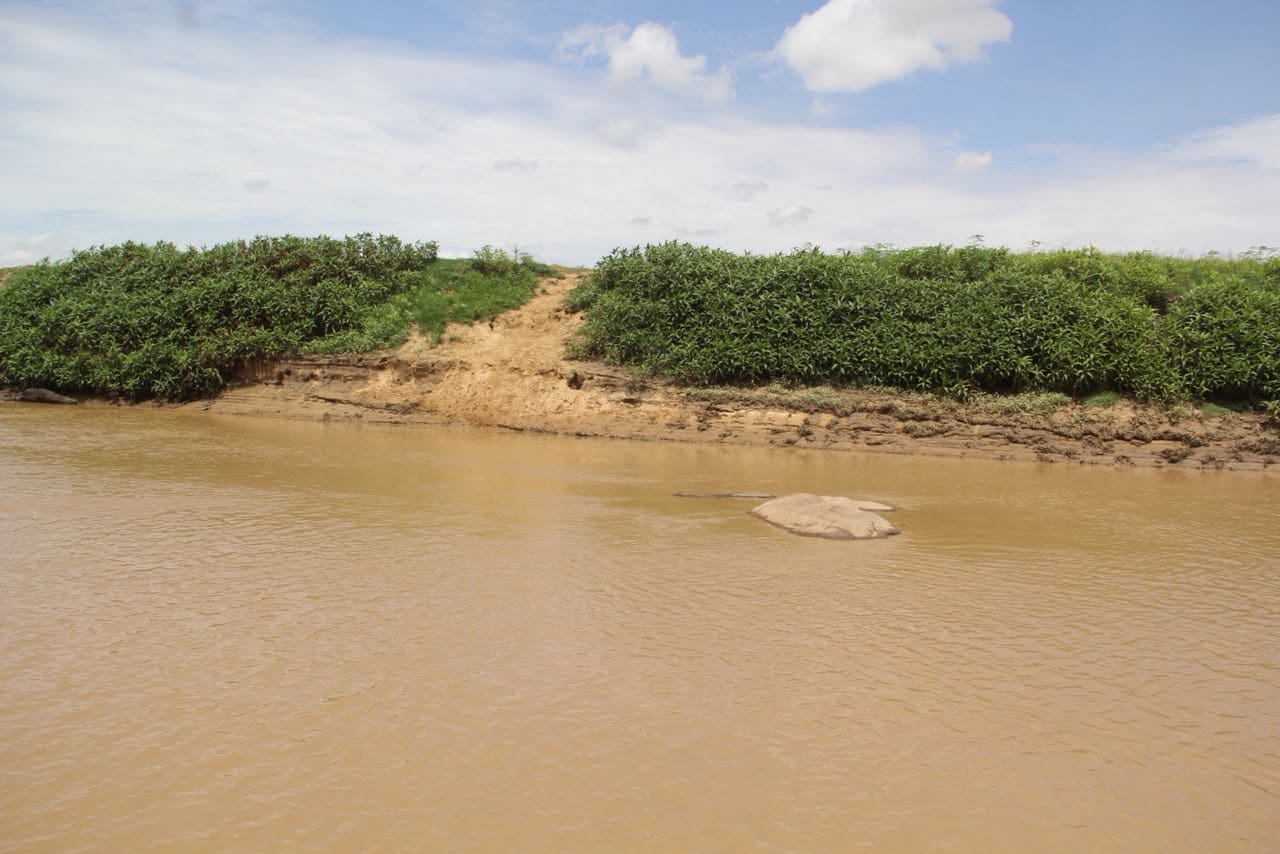
Another section of Lake Kainji in Kebbi State, where residents say a significant portion of the lake bed has dried up.
Muhammad Ahmad, 32, said his family has also struggled as farming becomes less reliable. He recalled one season when the lake receded before his rice matured, leaving him unable to afford the fuel required for irrigation.
“I had to work as a labourer,” he said. “Whatever money I earned, I used it to buy fuel and irrigate only part of the farm. When harvest came, I realised I had not even obtained one-third of my usual yield.”
He added that when the head of a household has little or no income, the effects are felt across the entire family.
Sedimentation adds to pressure on Lake Kainji
Lake Kainji was created in 1968 following the construction of Kainji Dam across the River Niger. The reservoir, covering roughly 1,300 square kilometres, supports irrigation, fishing, transportation and hydropower generation, providing livelihoods for thousands of households in Kebbi and Niger states.
But residents of communities around the lake say the landscape has changed dramatically. Areas that were previously covered by water have become exposed, with rocks and sand deposits visible across sections of the lake bed.
Some former waterways are now used as paths by motorcycles, pedestrians and vehicles.
Residents attribute the changes to a combination of declining water levels, sedimentation and changing weather and hydrological conditions.
Sedimentation occurs when soil, sand and other materials transported by rivers accumulate inside a reservoir, reducing its storage capacity and changing water movement.
A 2024 study on sedimentation in the reservoir of the Kainji Hydropower Plant identified sediment accumulation as a growing concern because of its potential effect on the reservoir’s long-term capacity to store and distribute water efficiently.
Climate change is adding another layer of pressure, with rising temperatures, changing rainfall patterns and increased evaporation affecting freshwater systems across Northern Nigeria.
Threat to food security
The consequences could extend well beyond the communities around Lake Kainji.
Kebbi is one of Nigeria’s major producers of rice, tomatoes, onions and other food crops, with irrigation playing an important role in sustaining production.
Food security expert, Azeez Salawu, warned that continued deterioration of irrigation water around Lake Kainji could significantly affect food production in the state and worsen Nigeria’s food security problems.
“When the water becomes unreliable, farmers are forced to reduce the size of cultivated land, delay planting and, in some cases, abandon production altogether,” Salawu said.
He said lower output from a major food-producing state would affect food availability across Nigeria, potentially putting further pressure on prices.

28-year-old Shehu Tsamiya Hazjazu
“At a time when we are still trying to address the issue of high inflation, any decline in agricultural output from a major food-producing region would further compound the crisis,” he said.
The warning comes against the backdrop of broader declines in crop production.
AFEX data cited in the report showed that the area cultivated for maize fell from 6.2 million hectares in 2021 to 5.8 million hectares in 2022, and from 5.10 million hectares in 2023 to 5.06 million hectares in 2024.
Rice production also fell to 5.23 million metric tonnes in 2024 from 5.61 million tonnes in 2023 and 5.41 million tonnes in 2022.
The Food and Agriculture Organisation had projected in October 2025 that 34.7 million Nigerians could face severe food insecurity by mid-2026 as climate pressures combined with economic difficulties and conflict.
Fishermen also feel the impact
The changing water conditions are not affecting crop farmers alone. Fishermen in communities around Yauri and the River Niger say declining water levels, sedimentation and shrinking channels are reducing their catches.
Usman Muhammad, 40, said he can spend an entire day fishing and return with only about N6,000 worth of catch.
“Sometimes we leave early in the morning and spend the whole day trying our best, only to earn about N6,000,” he said.
“At that point, we simply return home and leave the rest to God.”
Muhammad said fishing becomes particularly difficult during the dry season as fish populations decline in shallow areas. He said fishermen now travel longer distances to communities where water remains deeper in search of better fishing grounds.
“The river has become filled with silt and sediment,” he said. “If the river were deeper, fish would have places to hide and thrive.”
He suggested dredging sections of the river and removing accumulated sand to improve fishing conditions.
The decline in fish catches adds to Nigeria’s existing supply gap. Fish provides about 40 percent of the country’s protein intake, while annual domestic production of about 1.1 million to 1.4 million metric tonnes remains significantly below estimated demand of 3.6 million tonnes.
For communities that have depended on Lake Kainji and the River Niger for generations, the shrinking water supply is therefore becoming more than an environmental concern.
It is increasingly a threat to farm output, household incomes, food prices and the survival of livelihoods built around the water.
Tags
About the Author

Yakubu Ibrahim
Analyst
Abuja, Nigeria
Yakubu Ibrahim is an analyst who writes stories bordering on corruption, politics, and business. He has won four journalism awards and worked in two media organisations.